Ochoko, masu or wine glass: does the vessel really change the taste?
Yes, and more than you would expect. What each traditional vessel is for, why a wine glass often wins, and which ones to buy first.
 Sake
SakeIt sounds like the sort of thing that could not possibly matter. It does, and the effect is larger than for most drinks — because sake carries much of its character in aroma, and aroma is entirely at the mercy of the shape of the thing you drink from.
Here is what each vessel actually does, and what to buy.
The traditional set, and what each part is for
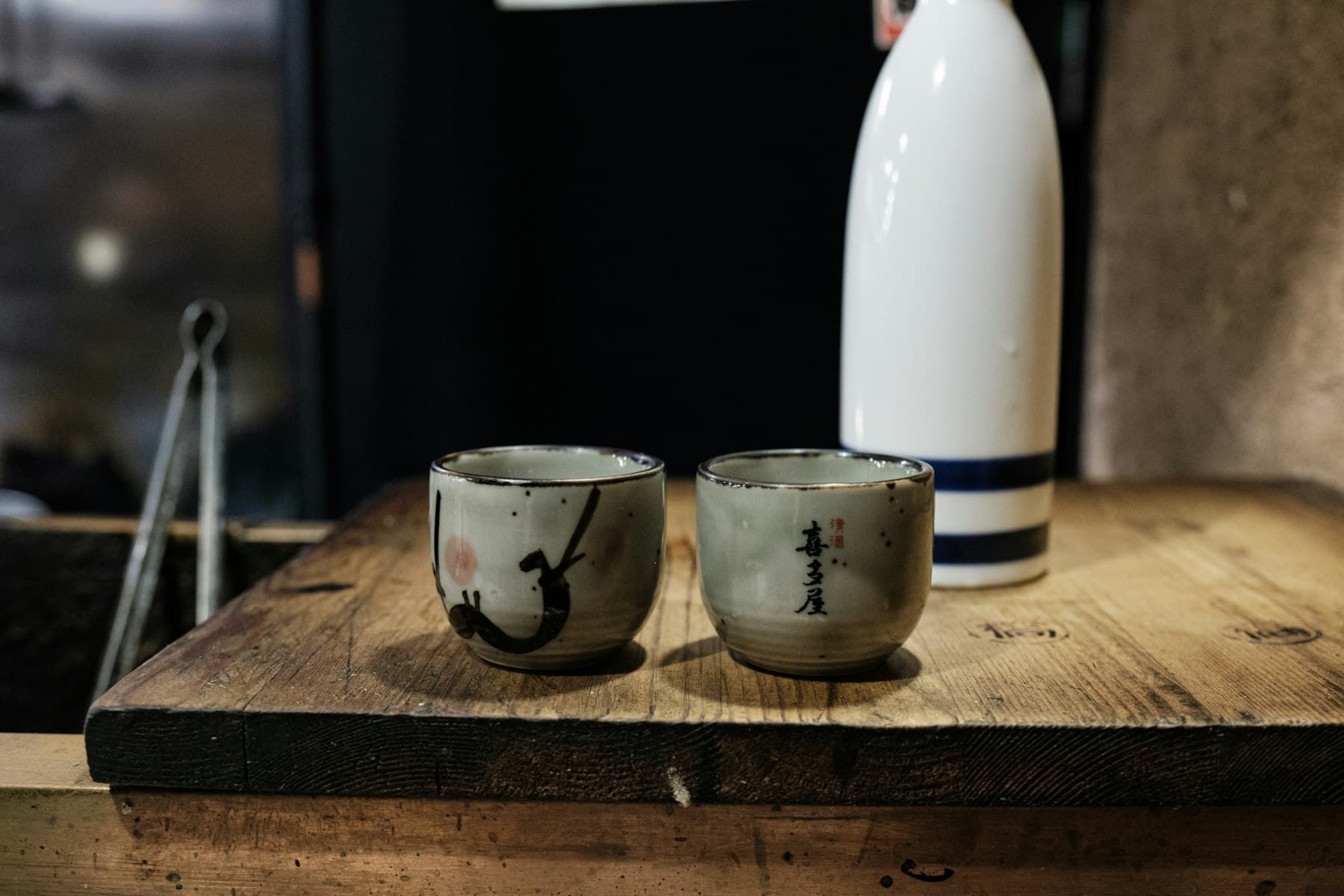
Ochoko (お猪口) — the small ceramic cup, holding a mouthful or two. Its virtues are social and thermal rather than aromatic: it is small so that others can keep refilling it for you, and ceramic holds heat, which suits warm sake. Its shortcoming is that there is no bowl to gather aroma.
Guinomi (ぐい呑み) — a larger cousin of the ochoko, "gulp cup." More forgiving, more your own drink than a shared ritual.
Tokkuri (徳利) — the narrow-necked flask. The neck is not decoration: the shape is designed to be stood in a pan of hot water, keeping the sake warm and slowing evaporation. If you warm sake, you want one. Our temperature guide covers the method.
Katakuchi (片口) — an open bowl with a lip, for pouring. Much better than a tokkuri for cold sake, because the wide open surface lets a closed-up bottle breathe. Think of it as a sake decanter.
Masu (枡) — the square wooden box, originally a measure for rice rather than a drinking vessel. It contributes a strong cedar aroma. On robust sake this is atmospheric; on a delicate daiginjo it is a bulldozer. Traditionally you may be served a glass standing inside a masu, deliberately overfilled so it spills over — mokkiri, a gesture of generosity rather than clumsiness.
Sakazuki (盃) — the wide, shallow, flared dish used at weddings and shrines. Ceremonial. Terrible for aroma, wonderful for occasions.
Why a wine glass often wins
For anything aromatic — ginjo, daiginjo, nama — a white wine glass beats every traditional vessel, and this is not a Western opinion imposed on the drink. Japanese sake competitions and professional tastings use glassware, and breweries increasingly recommend it for their aromatic bottlings.
The reason is simple physics. A bowl that narrows toward the rim collects volatile aromatics in the headspace and funnels them to your nose. An ochoko is a straight-sided cup: the aroma leaves sideways and never reaches you.
If you have spent extra on a highly polished, fragrant sake, drinking it from an ochoko discards most of what you paid for.
Which wine glass? A standard white wine glass, not a huge Burgundy bowl. Some manufacturers sell dedicated sake glasses; they work, but you do not need them to start.
What to use for what
| Sake | Vessel | Why |
|---|---|---|
| Daiginjo, ginjo, junmai ginjo | White wine glass | You paid for aroma; collect it |
| Namazake, sparkling | Wine glass, cold | Freshness and aroma are the point |
| Junmai, cold | Wine glass or guinomi | Both work; glass shows more |
| Warm sake (any style) | Ochoko + tokkuri | Ceramic holds heat; aroma needs no help |
| Kimoto, yamahai, warmed | Ochoko | Savoury depth, no delicate aromatics to lose |
| Robust junmai, room temp | Masu, if you like cedar | The wood adds to it rather than covering it |
| Ceremony, celebration | Sakazuki | Not about the taste |
Does the material matter?
Somewhat, and less than the shape.
Porcelain is neutral, smooth, and holds heat well. The safe default for ceramics.
Stoneware and rougher pottery change the mouthfeel — a thick, uneven rim genuinely alters how the liquid arrives. Whether that is an improvement is a matter of taste, and many people love it.
Glass is neutral and shows colour and clarity. For anything you want to smell, it wins.
Wood is not neutral at all. That is the entire point of a masu, and the reason not to use one with delicate sake.
Metal — tin cups (tin no choko) are traditional and said to soften the drink. Genuinely pleasant, and they get very cold very fast, which is useful.
What to buy first
If you are building from nothing, buy in this order:
- Nothing. Use a white wine glass you already own. This is not a compromise; it is the best vessel for the sake most beginners buy.
- A katakuchi. More useful than a tokkuri if you mostly drink cold sake, and it doubles as a serving piece.
- A tokkuri and two ochoko, when you start warming sake. This is the point at which ceramics become genuinely better rather than merely traditional.
- One good guinomi, chosen because you like it. This is the piece worth spending on.
Do not buy a boxed set. Sets pair mediocre pieces to hit a price, and you end up with five things you do not use. One good piece beats a box of six — the same logic applies when buying sake as a gift.
Two practical notes
Wash ceramics without strong detergent and let them dry fully. Unglazed stoneware in particular holds smells.
A tokkuri that has been used for warming should be dried thoroughly, or it will start to smell. Stand it upside down.
The short version
- Aroma-driven sake → wine glass. Not a compromise; the best choice.
- Warm sake → ochoko and tokkuri. Ceramic holds heat.
- Cold sake being served → katakuchi, which lets it open up.
- Masu is cedar, so use it only where cedar helps.
- Buy one good piece, never a boxed set.
Last verified 5 August 2026.
Common questions
What is the best glass for sake?
For aromatic styles — ginjo, daiginjo, nama — a white wine glass, because the bowl collects aroma and delivers it to your nose. For warm sake, a small ceramic ochoko, because it holds heat and the aroma needs no help. Those two cover almost everything.
What is a masu and should I drink from one?
A masu is the square wooden box, originally a measure for rice. It contributes a strong cedar aroma that overwhelms delicate sake, so it is best treated as ceremonial or used for robust styles. Traditionally a glass is placed inside the masu and overfilled as a gesture of generosity.
What is the difference between a tokkuri and a katakuchi?
A tokkuri is the narrow-necked flask, designed to be stood in hot water for warming. A katakuchi is an open lipped bowl for pouring, better for cold sake because the wider surface lets aroma open up. Use the tokkuri when you are warming, the katakuchi when you are not.
Do I need special sake glassware to start?
No. A white wine glass you already own is genuinely the best first vessel for cold sake. Buy ceramics when you start warming sake, and buy one good piece rather than a boxed set.
Read next
 Sake
SakeHow to store sake: before opening, after opening, and the one bottle that cannot wait
Sake is closer to wine than to whisky. Where to keep it, how long it really lasts, and why an opened bottle on the shelf is the most common mistake.
 Sake
SakeJunmai, ginjo, daiginjo: what sake grades actually mean
The eight legal sake designations, what the polishing percentage tells you, and how to read a Japanese label in about a minute.
SakeSake gift sets: what to buy, what to avoid, and what to tell the recipient
Most sake gift sets pair mediocre sake with a ceramic set nobody wanted. Here is what makes a good sake present, and the storage warning it needs.